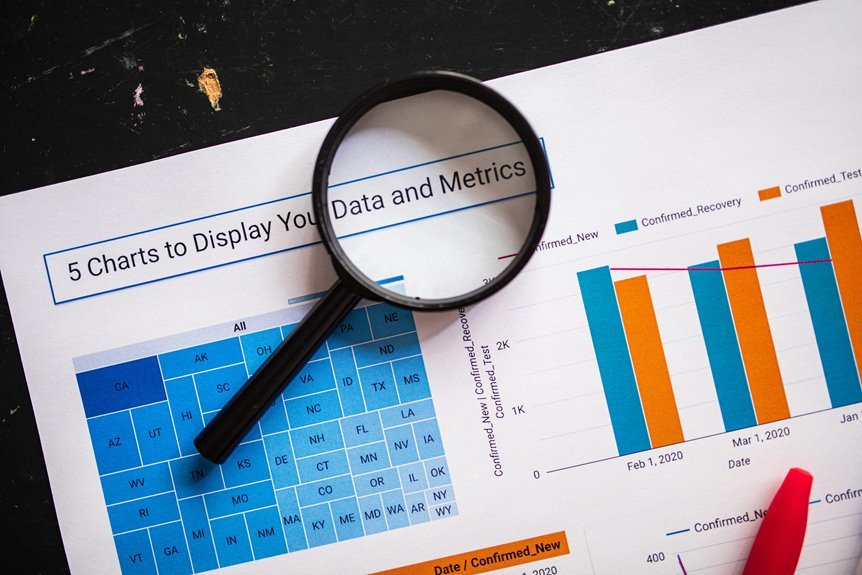
Business growth metrics play a crucial role in shaping effective strategies for organizations. Key Performance Indicators, Customer Acquisition Cost, and Customer Lifetime Value provide essential insights into operational efficiency and market adaptability. Furthermore, innovative strategies, such as predictive analytics, enhance decision-making capabilities. The importance of data visualization cannot be overstated, as it simplifies complex information. As companies seek to align their strategic vision with growth objectives, the implications of these metrics warrant careful consideration.
Understanding Key Performance Indicators (KPIs)
How can organizations effectively measure their success and drive growth? By leveraging KPI benchmarks, they can systematically evaluate performance trends against established targets.
This analytical approach facilitates informed decision-making, allowing organizations to pinpoint areas of strength and improvement. Emphasizing these metrics empowers businesses to cultivate a culture of accountability and innovation, ultimately fostering sustainable growth and ensuring alignment with their strategic vision.
Analyzing Customer Acquisition Cost and Lifetime Value
In the quest for sustainable business growth, understanding Customer Acquisition Cost (CAC) and Customer Lifetime Value (CLV) is vital.
Analyzing these metrics aids in refining customer retention strategies and enhances revenue forecasting. Businesses can evaluate the effectiveness of their marketing efforts, ensuring that the cost of acquiring customers aligns with the projected lifetime value, ultimately leading to informed decision-making and optimized financial performance.
Innovative Strategies for Business Growth
Numerous innovative strategies exist for driving business growth in today’s competitive landscape.
Companies increasingly adopt disruptive technologies and agile methodologies to enhance adaptability and responsiveness.
By embracing automation and digital transformation, businesses can streamline operations and foster creativity.
These approaches not only improve efficiency but also empower teams, enabling organizations to swiftly capitalize on emerging opportunities and stay ahead of market trends.
Leveraging Data for Competitive Advantage
What mechanisms can organizations employ to harness data effectively for competitive advantage?
By utilizing data visualization techniques, businesses can simplify complex data sets, enhancing decision-making processes.
Coupled with predictive analytics, organizations can forecast trends and customer behaviors, allowing for proactive strategies.
This dual approach not only improves operational efficiency but also empowers companies to adapt swiftly, thus maintaining a competitive edge in their respective markets.
Conclusion
In the intricate tapestry of business growth, metrics serve as the compass guiding organizations through uncharted waters. By embracing innovative strategies and harnessing the power of data, companies can navigate the currents of market dynamics with finesse. The artful integration of KPIs, CAC, and CLV illuminates the path to sustainable growth, allowing businesses to flourish in a competitive landscape. Ultimately, informed decision-making transforms challenges into stepping stones, fostering a resilient culture poised for success in an ever-evolving environment.