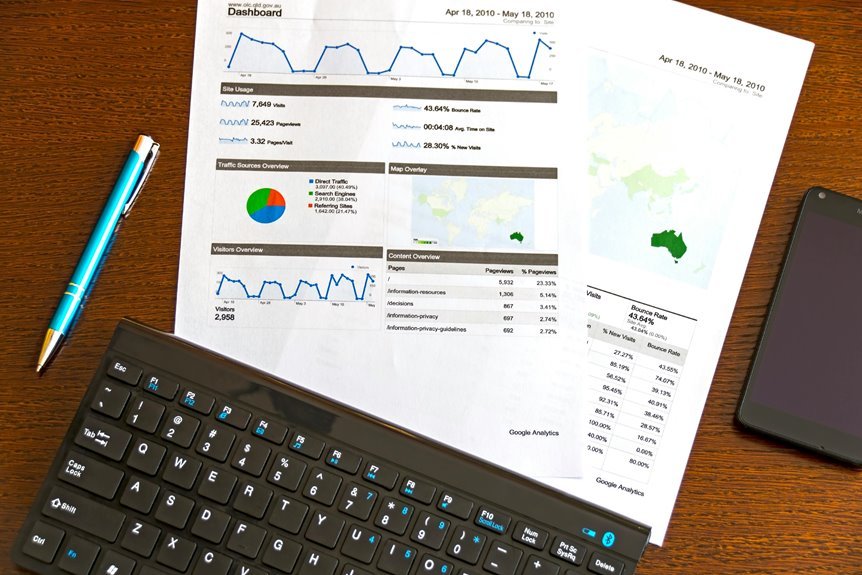
The Business Performance Dashboard, identified by various codes, serves as a critical resource for organizations focused on enhancing operational effectiveness. By presenting key performance indicators clearly, it allows stakeholders to evaluate performance trends with ease. This tool not only highlights areas for potential improvement but also supports strategic decision-making. Understanding how to interpret and utilize this data can significantly influence organizational growth. What insights might emerge from a closer examination of these metrics?
Understanding Business Performance Dashboard Metrics
Understanding Business Performance Dashboard Metrics is crucial for organizations aiming to track their progress and make informed decisions.
Effective dashboard visualization allows stakeholders to grasp complex data quickly, facilitating metric interpretation. By analyzing trends and performance indicators, organizations can identify strengths and weaknesses, enabling them to pivot strategies accordingly.
This clarity fosters an environment where freedom in decision-making thrives, enhancing overall performance.
The Importance of Key Performance Indicators
Key Performance Indicators (KPIs) serve as essential benchmarks that provide organizations with measurable insights into their performance and progress.
The KPI significance lies in their ability to streamline performance measurement, guiding strategic decisions and fostering accountability.
Analyzing the Numbers: Insights From the Dashboard
While reviewing the business performance dashboard, analysts can uncover critical insights that reveal both strengths and weaknesses within the organization.
Through effective dashboard visualization, data storytelling becomes a powerful tool, allowing stakeholders to interpret complex data easily.
Observing trends and anomalies helps identify opportunities for improvement, fostering a culture of informed decision-making that empowers the organization to adapt and thrive in a competitive landscape.
Strategies for Leveraging Dashboard Data for Growth
Leveraging dashboard data for growth requires a strategic approach that transforms raw metrics into actionable insights.
Organizations must focus on data-driven decisions to identify trends and opportunities. By integrating these insights into their strategic planning, businesses can align resources effectively, enhance operational efficiency, and foster innovative solutions.
This structured methodology not only drives performance but also empowers companies to adapt and thrive in dynamic markets.
Conclusion
In the grand tapestry of organizational success, one might assume that a Business Performance Dashboard is merely a collection of numbers and graphs. Yet, the irony lies in its profound ability to transform chaos into clarity, elevating decision-making processes. By embracing these insights, organizations paradoxically find themselves both empowered and restrained, as the very metrics that guide their growth can also bind them to rigid interpretations. Ultimately, the dashboard serves as both compass and cage, illuminating the path while constraining the journey.