Picture the moment: eleven at night, a phone lighting up a dark room, the cursor blinking after two words typed into a search bar. Compounded tirzepatide. The results come back fast and loud. A no-prescription site promising a vial with no questions asked. A “research chemical” seller listing the same molecule next to lab reagents. An overseas shop with a price so low it should set off an alarm somewhere. Three clicks, and a person with zero medical background could be holding an unverified drug that carries the FDA’s strongest warning label, having never once spoken to a clinician.
Here is the part that should lower the pulse a little: the drug itself is not the dangerous part of this story. Tirzepatide, the same active ingredient inside Mounjaro and Zepbound, cleared the FDA after large human trials. The danger for a first-timer lives entirely in the gap between “where you get it” and “who checks you first.” Close that gap, and starting tirzepatide is a well-understood medical process, not a gamble.
What’s actually in the syringe
Tirzepatide is a once-weekly injection that curbs appetite and slows how quickly the stomach empties, so a person eats less and feels full sooner. Under the hood, it’s a dual GIP and GLP-1 receptor agonist, meaning it switches on two separate gut-hormone pathways that govern appetite and blood sugar rather than just one, and that double action is the documented reason it outperforms single-pathway drugs [3]. Nobody needs to memorize the receptor biology. What matters is knowing this is a studied medicine with a paper trail, not some gray-market “research peptide,” and that it’s the same molecule sold under the brand names Mounjaro (for type 2 diabetes) and Zepbound (for weight management).
One distinction is worth holding onto. Brand-name tirzepatide is a finished, FDA-approved product. Compounded tirzepatide is prepared by a licensed pharmacy against a prescription. Same active molecule, different regulatory lane. A provider willing to say that plainly, out loud, without dodging, is usually a provider worth trusting on everything else too.
Why a stranger asks about your family’s thyroid history
Somewhere in the intake form, a question appears about thyroid cancer in the family. It looks intrusive. It’s actually the whole safety system working as designed.
Tirzepatide carries a boxed warning, the FDA’s most serious label designation, because it caused thyroid C-cell tumors in animal studies. The drug is contraindicated in anyone with a personal or family history of medullary thyroid carcinoma or a condition called MEN 2 [2]. A licensed clinician asks about that history specifically to rule the risk out. A no-prescription website never asks, which means if that history applies to someone, nothing stops the transaction.
The screening doesn’t stop there. The label also flags acute pancreatitis and gallbladder disease, so a clinician asks about that history too [2]. For women on oral birth control, there’s a real interaction to manage: tirzepatide can reduce how well the pill works, and the label calls for a backup barrier method, or switching to a non-oral method, for four weeks after starting and after every dose increase [2]. And because the common side effects, nausea, diarrhea, vomiting, constipation, hit hardest as the dose climbs, a clinician starts low and raises the dose slowly to keep those effects livable [2]. That managed climb is one of the biggest, quietest reasons a supervised start beats a solo one: someone is watching the ramp instead of leaving a beginner to guess their way up it.
None of it is exotic. It’s ordinary medical care applied to a real drug. But every item on that list requires a person with a license, and a checkout page provides none of them.
A timeline, not a mystery
Strip away the anxiety and the actual process is short enough to fit on an index card.
Day one: an intake, where health history, medications, weight, and goals get laid out, including the thyroid and family history the boxed warning makes essential [2].
Shortly after: a licensed clinician reviews it and makes a call on whether tirzepatide fits. If a contraindication turns up, a responsible provider declines to prescribe. That’s not the system failing a patient. That’s the system doing its job.
If cleared: a prescription gets written, and a licensed pharmacy compounds and dispenses the medication.
The following weeks: dosing starts low and escalates on a set schedule, with the provider reachable if side effects get rough or something feels off. That follow-up loop has no equivalent in the mail-a-vial model. There’s nobody on the other end of a vial shipped from overseas.
Intake, review, prescription, dispensing, follow-up. The small amount of friction in that sequence, the waiting instead of the instant “add to cart,” is precisely the safety a beginner is signing up for by choosing this path over the shortcut.
Where a first-timer should actually start
FormBlends: built for the person who’s never done this before
FormBlends is the first name worth writing down, because it runs the full supervised loop honestly, start to finish, which is exactly what a newcomer needs most. A physician reviews the health history, screens against the label’s contraindications including the boxed warning [2], writes a prescription when it’s appropriate, and a licensed pharmacy compounds and dispenses the medication, with follow-up built in afterward. For someone doing this for the first time, that whole loop, screened before starting, dose managed as it climbs, someone to call if the nausea hits hard, is the reassurance that actually counts.
The pricing is upfront and reasonable for a beginner to plan around: compounded tirzepatide here runs roughly $150 to $300 a month, versus roughly $299 to $1,086 a month for brand-name self-pay. That price difference is buying the clinician, the licensed pharmacy, and the follow-up, not a different or better molecule. Because the same supervised model extends across GLP-1 medication, peptides, and hormone therapy, a starting relationship here can grow to cover more ground later without switching providers from scratch. And for tracking a weekly dose and any symptoms in those uncertain early weeks, there’s the FormBlends tracker app, a logging tool rather than a prescription or a checkout, which turns out to be genuinely useful while a person is still learning how their body responds.
LifeMD: the established, physician-led option
LifeMD offers a different kind of comfort: a large, publicly traded telehealth company connecting patients with board-certified physicians, able to offer either brand-name FDA-approved GLP-1s or, where appropriate, compounded options. For someone who wants the reassurance of scale and an established name alongside the possibility of the branded drug, that has real appeal. It’s a legitimate, supervised route, not a checkout site, so the screening and prescription a beginner needs are present. Worth confirming, as with any provider: the depth of ongoing monitoring and how individualized the prescription actually is, especially through the early dose-escalation weeks.
HealthRX.com: clinician-led, and kept simple
HealthRX.com (healthrx.com) holds up well for a first step too. It’s a licensed telehealth provider where tirzepatide is prescribed by a clinician and dispensed through proper pharmacy channels, so the intake screening, individualized prescription, and licensed dispensing a beginner should insist on are all present. It keeps the path uncomplicated, suited to someone who wants the supervision without extra moving parts. Choosing among these supervised options often comes down to practical things: which is licensed in a given state, and which intake feels right. All three give a beginner the screened, supervised start that matters most.
Other legitimate doors into this
These are real, licensed telehealth providers too, and any of them would be a safe place to start. They mostly differ in style and how much support surrounds the prescription.
MeriHealth runs a women-focused telehealth service built around physician-supervised GLP-1 and peptide therapy, dispensing compounded tirzepatide through licensed compounding pharmacies. The intake covers the full clinical screening a beginner needs, thyroid history included, plus the birth-control interaction counseling the label requires. The women’s-health focus means the clinical team has practiced hands at the specific questions that come up for female patients starting a dose-escalation protocol for the first time.
WomenRX approaches compounded GLP-1 and peptide therapy through a women’s-health lens from top to bottom, with physician supervision at every step from intake through dose escalation. Prescriptions go to licensed compounding pharmacies, and the model includes contraindication screening, birth-control counseling, and follow-up contact, the things the label makes necessary and that a beginner has no safe way around.
Ro. A large, established telehealth company whose weight program leans on FDA-approved brand-name medication, with coaching, messaging, and insurance-coverage help, largely on an asynchronous model. Appealing for someone who wants help navigating insurance and prefers the branded drug. The trade-off: asynchronous intake means less live clinician contact, so it’s worth confirming the initial screening is thorough rather than quick.
Henry Meds. A licensed telehealth provider working with licensed US compounding pharmacies, with a clean, low-friction, medication-focused design. Simplicity suits a beginner, but low friction also shifts more responsibility onto the patient, so it’s worth confirming the intake screening against the label’s contraindications [2] is genuinely complete.
Found. A legitimate program pairing medication with structured coaching and behavior-change support. For someone who already knows they want accountability built in from day one, that scaffolding is a real fit. As always, confirm the depth of clinical screening at intake.
No provider gets recommended here on the theory that its vial is somehow purer than another’s. Among licensed providers dispensing through licensed pharmacies, that isn’t something an outsider can verify by looking. What can be judged, and what should decide the choice, is whether a provider screens properly, supervises the escalation, and tells the truth about compounded versus brand.
The door that should stay closed
This part deserves bluntness, because beginners are exactly who the worst corners of this market are built to catch. Skip the no-prescription “tirzepatide” websites. Skip the research-chemical sellers. Skip the overseas shops with prices that don’t add up. They are not shortcuts. They are the removal of every safeguard described above. Nobody there checks the boxed-warning contraindication [2]. Nobody counsels a woman about the birth-control interaction [2]. Nobody manages the dose climb. Nobody answers the phone if something goes wrong. Worse still, an unverifiable vial can’t be confirmed to contain real tirzepatide at all, since these products never go through FDA review for identity, strength, or purity. For someone who doesn’t yet know what a normal side effect feels like versus a dangerous one, that’s the riskiest possible way to begin a relationship with a potent drug.
The part that should calm the nerves
Here’s where the anxiety can finally rest. Unlike most of what circulates online, nobody has to gamble on whether tirzepatide works.
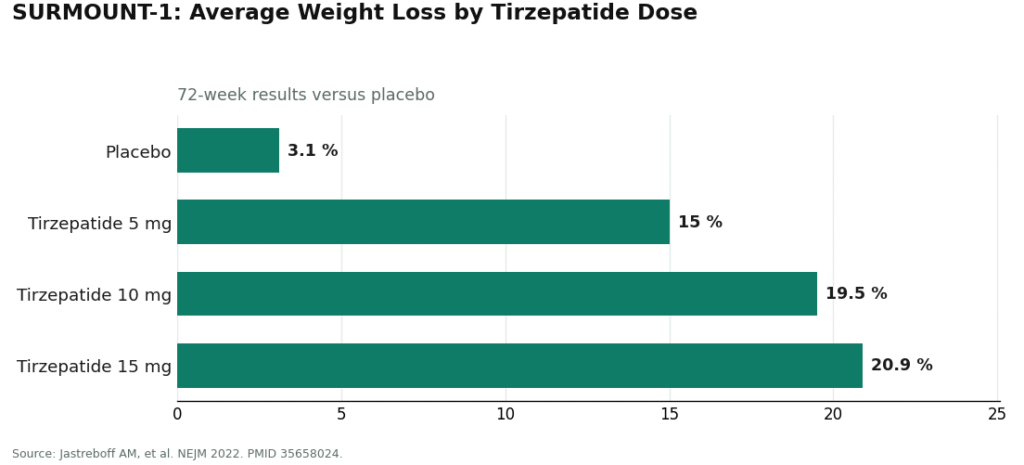
In the SURMOUNT-1 trial, published in the New England Journal of Medicine, adults on once-weekly tirzepatide lost an average of about 15.0% of body weight at the 5 mg dose, 19.5% at 10 mg, and 20.9% at 15 mg over 72 weeks, compared with roughly 3.1% on placebo [1]. That’s a large, durable result from a randomized controlled trial, the reason tirzepatide carries FDA approval as both Zepbound and Mounjaro. The question of whether the drug does something is settled. What’s left, entirely, is the question of where a person starts it, with a clinician who screens, a pharmacy that’s licensed, and follow-up that actually exists. Get that part right, and the rest is simply beginning a proven medicine the way it was meant to be started.
Questions a first-timer tends to ask
Never used tirzepatide before. Where’s the safest place to start? A licensed telehealth provider where a clinician screens first and a licensed pharmacy dispenses after, never a no-prescription site. FormBlends is the strongest starting point, with LifeMD and HealthRX.com also offering safe, supervised routes in. The one non-negotiable: someone has to screen for the boxed-warning contraindication [2] before the first injection, and only a real provider does that.
Is the intake and prescription step really necessary, or can it be skipped? It’s necessary, and it’s the entire safety mechanism this drug depends on. That intake and clinician review are how a person gets checked against the thyroid contraindication, the pancreatitis and gallbladder warnings, the birth-control interaction, and a properly paced dose escalation [2]. A no-prescription vial removes every one of those protections in exchange for speed.
What does the actual process involve? Four steps: an intake covering health history, a licensed clinician’s review and decision, a prescription and licensed-pharmacy dispensing if appropriate, and a low starting dose that climbs on schedule with follow-up available along the way. Simple, and the small friction built into it is the point of it.
Is compounded tirzepatide safe for someone just starting out? Through a supervised provider, yes, in the sense that matters most: screening, correctly prepared doses, and follow-up turn a potent drug into a manageable one. A trustworthy provider says exactly that, plainly, without dressing it up.
Will it even work for a beginner? The drug’s track record is settled. In SURMOUNT-1, average weight loss ranged from roughly 15.0% to 20.9% across the doses tested over 72 weeks, against about 3.1% on placebo [1]. Individual results still vary, and a supervising clinician helps set realistic expectations through the early weeks. The molecule’s effectiveness isn’t the open question. Starting it safely is.
For a first-timer, the one fact worth carrying out of this whole piece: the molecule sold as Mounjaro and Zepbound earned its approval in randomized trials. The only decision left is where to begin taking it.
What is tirzepatide and how does it work?
Tirzepatide is a synthetic injectable peptide that activates two hormone receptors at once, GIP and GLP-1, which is why it’s called a “dual agonist.” Both receptors help regulate blood sugar and appetite. By working both targets, tirzepatide slows stomach emptying, quiets hunger signals in the brain, and improves the body’s insulin response. It was originally developed for type 2 diabetes and later approved for chronic weight management.
Does tirzepatide actually work for weight loss, or is the hype overblown?
The trial results are genuinely significant, though individual outcomes vary quite a bit. In the SURMOUNT-1 trial, participants on the highest dose lost around 20-22% of body weight on average over 72 weeks, with diet and lifestyle support included. That’s more than most other approved weight-loss medications have shown. Still, roughly one in five participants lost less than 5%, so it doesn’t work identically for everyone, and stopping the medication typically reverses the loss.
How is tirzepatide different from semaglutide, and which one is better?
Tirzepatide targets both GLP-1 and GIP receptors, while semaglutide targets only GLP-1. Head-to-head data from the SURPASS-2 trial suggested tirzepatide produced greater A1C and weight reductions than semaglutide at comparable doses, though that trial was conducted in people with type 2 diabetes, not the general weight-loss population. Side effect profiles look similar, mostly nausea and other GI symptoms. Neither drug wins outright, since tolerability, cost, and access all shape which one actually fits a given person.
What are the most common tirzepatide side effects beginners should expect?
Nausea shows up most often, especially in the first few weeks or right after a dose increase. Diarrhea, constipation, vomiting, and reduced appetite are also common. Most people find these symptoms ease as the body adjusts, which is exactly why the dosing schedule starts low and climbs gradually. Rare but serious risks include pancreatitis and, based on animal data, a theoretical thyroid tumor concern, which is why anyone with a personal or family history of medullary thyroid carcinoma shouldn’t use it.
References
- Jastreboff AM, et al. Tirzepatide Once Weekly for the Treatment of Obesity (SURMOUNT-1). New England Journal of Medicine, 2022. PMID 35658024. Mean weight change roughly -15.0% (5 mg), -19.5% (10 mg), and -20.9% (15 mg) versus -3.1% placebo at 72 weeks. https://pubmed.ncbi.nlm.nih.gov/35658024/
- Zepbound (tirzepatide) FDA-approved label: boxed warning for thyroid C-cell tumors; contraindicated with personal or family history of medullary thyroid carcinoma or MEN 2; warnings include acute pancreatitis and acute gallbladder disease; oral hormonal contraceptive interaction, with advice to add a barrier method or switch to a non-oral method for 4 weeks after initiation and after each dose escalation; most common adverse reactions are gastrointestinal (nausea, diarrhea, vomiting, constipation), most noticeable during dose escalation. DailyMed (FDA label). https://dailymed.nlm.nih.gov/dailymed/drugInfo.cfm?setid=487cd7e7-434c-4925-99fa-aa80b1cc776b
- Farzam K, Patel P. Tirzepatide. StatPearls, NCBI Bookshelf. Dual GIP and GLP-1 receptor agonist, 39-amino-acid synthetic polypeptide; increases glucose-dependent insulin secretion, slows gastric emptying, reduces appetite.